
On the Weekly Torah Portion of Chayey Sarah
 Even though this week’s Torah portion is called chayey sarah (Genesis 23:1 – 25:18), “The Life of Sarah,” the longest part of this parashah deals with the marriage of Isaac with Rebecca. Abraham is making his chief slave, Eliezer, who was the overseer of all his affairs, swear that he will find a wife for Abraham’s son Isaac not among the local Canaanites but back in Haran, which is where Abraham’s relatives still lived.
A number of commentators noted that during his conversation with Eliezer, Abraham refers to God in two different ways. First, he makes Eliezer swear in the name of the God of heaven and earth:
On the Weekly Torah Portion of Vayera
 This week’s weekly Torah portion, vayera (Genesis 18:1 – 22:24), continues to focus on the patriarch Abraham, whose epic life can be seen as a metaphor for the ideal spiritual path. It is in this week’s parashah that Abraham is undergoing the most demanding spiritual test that anyone can possibly undertake: the sacrifice of his son Isaac.
On the face of it, this is a cruel and inhuman story. There are few things more barbaric than human sacrifice, and one wonders why such a story is part of Abraham’s life. In his book, The Weekly Parashah in Human Language, Avraham Burg, a practicing orthodox Jew who served as a Speaker of the Knesset and Chairman of the Jewish Agency, writes: “It cannot be that Judaism, which is a religion of humans as much as it is a faith in God, would turn Abraham’s willingness to sacrifice his sons into evidence for the right faith. If this is faith, it is not my faith. If this is success, I wish to fail. My children! Your life and your longevity, my beloved, are the very essence of my faith. For you the world was created and for you I wish to change it and repair it.” (Burg is talking about “sons” in the plural, because earlier in the parashah Abraham banishes his other son Ishmael, along with his mother, Hagar).
On the Weekly Torah Portion of Lekh Lekha
Throughout life one asks the same question in many forms. This question lies at the heart of a search for oneself, a search that begins with the first glimmer of consciousness and continues to the very last breath. For every human being it varies, and at every state of his life…. One never really extricates oneself from the context of the issue, Who am I?… Virtually all of the investigation a person ever does, whether of himself or of problems outside himself, consists for the most part of pyramids upon pyramids of answers to that basic question about the essence of his being.(Rabbi Adin Steinsaltz, The Thirteen Petalled Rose)
 This week’s Torah portion, lekh lakha (Genesis 12:1 – 17:27), is the first portion that addresses the Jewish story. Previous portions, bereshit and noach, dealt with humanity as a whole; from this point on, however, the Torah deals exclusively with the Jewish people. Just as the sprouting of an acorn contains within it the entire oak tree in condensed form, and just like the first verse of the Torah is said to include the entire Torah in it, so one may expect that the opening words of this parashah express Judaism in condensed form.
Here is the first pasuk, the first verse:
לֶךְ לְךָ מֵאַרְצְךָ וּמִמּוֹלַדְתְּךָ וּמִבֵּית אָבִיךָ אֶל הָאָרֶץ אֲשֶׁר אַרְאֶךָּ.Go from your country and your birthplace
and your father’s house
to the land that I will show you.
(Genesis 12:1)
On the Weekly Torah Portion of Noah
(וַיֹּאמֶר אֱלֹהִים לְנֹחַ… עֲשֵׂה לְךָ תֵּבַת עֲצֵי-גֹפֶר (בראשית ו’ י”ג-י”ד
And God said to Noah… Make yourself an ark of cypress wood
(Genesis 6:13-14)
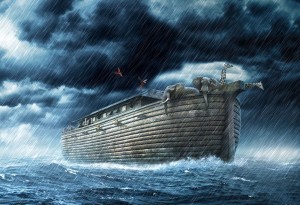 The story of Noah and the flood, which is the subject of this week’s parashah (weekly potion of the Torah reading, Genesis 6:9 – 11:32), has excited the imagination of both children and adults for millennia. So much so, that numerous attempts have been made to locate physical remains of the ark in an effort to prove that the flood “really” happened, i.e., happened in the world of space and time. But would such a finding change us spiritually? Perhaps a more useful perspective would be to see the Noah story as a guide for reaching beyond space and time and establishing a new alliance with the Eternal.
On The Weekly Torah Portion of Bereshit

What better place to start a blog, than on the first words of the Bible? This post was written at the invitation of Rabbh Kaya Stern-Kaufman and was sent to the mailing list of her organization, Rimon, A Resource Center for Jewish Spirituality.
בראשית ברא אלהים את השמים ואת הארץ (בראשית א’ א)In the beginning God created the Heavens and the Earth
(Genesis 1:1)
This week’s parashah (weekly Torah reading), bereshit (Genesis 1:1 – 6:8) is the first parashah of the Torah. It contains the story of creation and the opening lines of the Bible: “In the beginning God created the heavens and the earth” (bereshit bara elohim et hashamayim ve-et ha’aretz). Often mistaken by religious fundamentalists to be a chronological account of the actual physical processes through which the universe was brought into being, it is in fact a metaphorical, metaphysical map of the sequential emergence of duality out of unity.