
On the Weekly Torah Portion of Vayigash
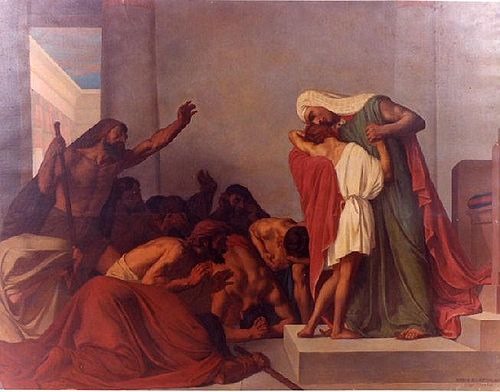 This week’s Torah portion, vayigash (Genesis 44:18 – 47:27) is the third parashah devoted to the story of Joseph, Jacob’s favorite son. At this stage of the story, Joseph serves as Pharaoh’s viceroy and is the de-facto ruler of Egypt.
In last week’s Torah portion, Joseph’s brothers, who had previously sold him to slavery and were not yet aware of his rise to power, came to Egypt to collect grain to save themselves from the great famine that took over the region. They were sent to Egypt by their father, Jacob, who kept the youngest of his sons, Benjamin, with him at Canaan. Still traumatized by the loss of Joseph, whom he thought for dead, Jacob did not want to risk the life of Benjamin.
But Benjamin was precisely whom Joseph was most eager to see. He and Benjamin were the only sons born of Jacob’s favorite wife, Rachel. Benjamin was still a child when Joseph’s other brothers betrayed him, thus he was not part of the conspiracy. Without revealing his identity, Joseph manipulated the situation so that the brothers had to bring Benjamin down from Canaan to Egypt. He then proceeded to frame Benjamin for a fictitious theft, insisting, to the great distress of the brothers, that Benjamin must become his slave to atone for the crime.
This parashah starts at the dramatic moment when Judah approaches Joseph. Not knowing that he is talking to his own brother, he addresses him as the king’s viceroy, and in a desperate attempt to reason with him, tries to get Benjamin freed in order to bring him back to Jacob, even at the price of his (Judah’s) own freedom.
The parashah opens with the words:
וַיִּגַּשׁ אֵלָיו יְהוּדָה, וַיֹּאמֶר בִּי אֲדֹנִי, יְדַבֶּר-נָא עַבְדְּךָ דָבָר בְּאָזְנֵי אֲדֹנִי, וְאַל-יִחַר אַפְּךָ בְּעַבְדֶּךָ: כִּי כָמוֹךָ, כְּפַרְעֹה.Then Judah approached him and said, “Please, my lord, let your servant speak a word in my lord’s ears, and do not be angry with your servant; for you are like Pharaoh himself. (Genesis 44:18)
The obvious meaning of the first few words, “Then Judah approached him,” is that Judah approached Joseph. However, a number of Hassidic rabbis, including Rabbi Elimelech of Lizhensk, take the “him” to refer to God. Which means that the words “Then Judah approached him” actually refer to prayer.
In this context, Judah’s first two words are highly significant. He says: bi adoni (בִּי אֲדֹנִי). The idiom is translated as “please, my lord”, but it literally means “my lord is within me.” Significantly, the Hebrew word adoni, “my lord”, is spelled in exactly the same way as the Hebrew word adonay, the most commonly used name of God.
So how does Judah “approach God” (i.e., prays)? He first recognizes that adonay, i.e., God, is bi (בִּי), i.e., within himself. And given that Judah is the progenitor of the tribe of Judah, i.e. the forefather of all the Jews, we are being told something fundamental about Jewish prayer.*
This point is further highlighted in this week’s haftarah** reading. The haftarah ends with the words,
…בִּהְיוֹת מִקְדָּשִׁי בְּתוֹכָם, לְעוֹלָם.…when my sanctuary is among them forevermore. (Ezekiel 37:28)
The words “among them” are a translation of the Hebrew word betokham (בתוכם), which also means “inside them” or “within them.” It indicates that the house of worship, the temple, is not a structure of bricks and mortar but rather a structure within the self, within one’s awareness, at the deepest level of one’s consciousness.
These two passages together give us a profound message, one that is found in the mystic traditions of all great religions: that the one who prays, the act of praying, the hall of prayer (the sanctuary) and the object of prayer are ultimately all one. The self does the praying, the self is the prayer, the self is the place where the prayer takes place and the self is also the object of the prayer.
* * *
As the saying goes, “the Torah has seventy faces.” That is to say, each passage in the Torah can be interpreted in myriad of ways. We have derived an important lesson from Rabbi Elimelech’s commentary that the word “him” in the expression “Then Judah approached him” refers to God. Another profound lesson can be derived from the text if one assumes that indeed the “him” refers to Joseph, as the literal context would suggest.
Judah approaches Joseph and says, bi adoni, “my lord, you are within me.” Here the Torah teaches us the fundamental lesson of human relationship, i.e., that the highest form of communication is the recognition that one is not separate from the other, that the consciousness of both is one and therefore, fundamentally, the two are one.
Judah alludes to this truth of relationship a few verses down, as he continues his plea for the release of Benjamin, offering himself as a slave in his stead. The reason? Their old father, says Judah, loves his youngest son very deeply and the separation from him would be unbearable. The expression that Judah uses is “his soul is bound with his soul”, venafsho kshurah benafsho (וְנַפְשׁוֹ קְשׁוּרָה בְנַפְשׁוֹ:) (Genesis 44:30). Another way of translating it is “their souls are intertwined.” That is the most profound form of relationship: the connection is so deep that the two see their souls as one soul.
This is a fundamental lesson in Judaism, one what will be encountered later in the Torah in the famous dictum “Love your neighbor as yourself”, veahavta lere’akha kamocha (וְאָהַבְתָּ לְרֵעֲךָ כָּמוֹךָ) (Leviticus 19:18). One must love one’s neighbor as oneself because the neighbor is oneself. In the 20th century, the Jewish German philosopher and noted Hassidic scholar Martin Buber applied this principle in his teaching about the highest form of communication and dialogue, which he referred to as the principle of “I-Thou.”
Buber observed that normally our communication with each other is what he called an “I-it” communication: I am the subject, while the other is an object, an “it”, whose “role” is to fulfill a need of mine. By its very nature, this mode of communication is based on separation and is confrontational, however civilized. But in “I-Thou” communication, there is no such separation because both parties are grounded in the realization that nafsho ksuhrah benafsho, their souls are intertwined and it is impossible to tell where one ends and the other starts. This higher form of communication is inherently free from conflict: when there is unity, there is no conflict. Communication then becomes a sacred act.
This may be the highest contribution of the Torah to life in the 21st century: inspiring a different mode human interaction where the act of communication itself is the highest form of worship, of “approaching God” in the other. This theme will surely be visited in future posts on this blog.
—————————————
* As in the commentary on vayetze, here too one could show that this point can be found in all major traditions: from “The Kingdom of God is within you” in the New Testament (Luke 17:21) to the declaration of immediate closeness of God in the Qur’an “We are nearer to him [man] than his jugular vein” (Surah 50:16), through the Confucian quote”what the undeveloped man seeks is outside, what the advanced man seeks is within himself.”
** The recitation of scripture at the synagogue on Shabbat morning includes not only a parashah, a weekly Torah portion, but also a haftarah, a portion from the prophets section of the Hebrew Bible, generally one which has some thematic resemblance to that of the parashah.
Copyright © 2014 Igal Harmelin-Moria
(Copyright does not pertain to illustrations)
[…] via On the Weekly Torah Portion of Vayigash […]
Kol HaKavod
Toda Raba!
[…] *See a similar comment in the commentary on vayigash […]