
On The Weekly Torah Portion of Va-yechi
 This week’s Torah portion, va-yechi (Genesis 47:28 – 50:26), is the concluding parashah of the book of Genesis, and the bulk of it deals with the passing of Jacob and his blessings to his sons and two of his grandsons. Jacob leaves his sons specific instructions with regard to where his body should be buried: in the Machpelah cave, the burial ground purchased by Abraham where Abraham, Sarah, Isaac, Rebecca, and Leah are all buried. Joseph takes a temporary leave from Pharaoh and travels to Hebron with all his brothers to bury their father according to his last wishes.
The Midrash, the allegorical level of interpretation of the Torah, adds some revealing details about Joseph’s action in his short visit to the land of his birth. According to Midrash Tanhuma, at the conclusion of the burial ceremonies, Joseph goes to Shekhem to visit the pit into which he was thrown by his brothers before they sold him as a slave to the Ishmaelite merchants.
Imagine what must have come up in his mind when he saw the pit. This is the location where an act of great injustice—a major betrayal—was performed against him by his own flesh and blood, his older brothers who were supposed to care for him and protect him. They threw him into the pit with the intention of eventually killing him. Think of the shock, fear, despair, helplessness and anger that Joseph must have felt at the time of the event, and how all these emotions would have flooded him upon visiting the site of the atrocity.
We would expect that the midrash would report how Joseph expressed some of those emotions at the site. But Joseph was no ordinary man. He is the archetype of the ideal tzaddik, the perfectly righteous man. His response was as big-hearted as can be. The midrash tells us, that upon reaching the pit, Joseph recited a blessing, the one that one is supposed to recite when a miracle occurs: “Blessed is He who has caused a miracle to occur for me in this location.”
How could he do this? How could he have avoided all those floods of memories and emotions? Was he disconnected from his feelings, a kind of a robot? Hardly so. The Torah tells us of a few instances where Joseph could not hold his tears back while speaking with his brothers. He was a softy, when it came to his emotions. Yet as a tzaddik, he did not respond to his emotions blindly. He took the whole situation into account.
For starters, he was aware of how nervous and anxious his brothers were. As the Torah tells us, after Jacob’s death they were afraid that in the absence of their father, Joseph would take revenge. Furthermore, as he had already told them when he first revealed his identity to them, had it not been for their betrayal, he would not have become Pharaoh’s viceroy, his family would not have been saved and the race of the People of Israel, promised by God, would not have become a reality. Being thrown into the pit enabled something miraculous to happen; hence he uttered the blessings.
There is a fantastic lesson here: the midrash tells us that a true tzaddik, someone who is truly connected to God, always strives to maintain the most positive outlook, the most big-hearted perspective, even when overcome by enormous challenges and difficulties. Said differently: a tzaddik is someone whose consciousness is very wide, who maintains the highest perspective without contracting.
As the book of proverbs says:
כִּי שֶׁבַע יִפּוֹל צַדִּיק וָקָם וּרְשָׁעִים יִכָּשְׁלוּ בְרָעָה.The tzaddik, though he fall seven times, will rise again; but the wicked are overthrown by calamity. (Proverbs 24:16)
* * *
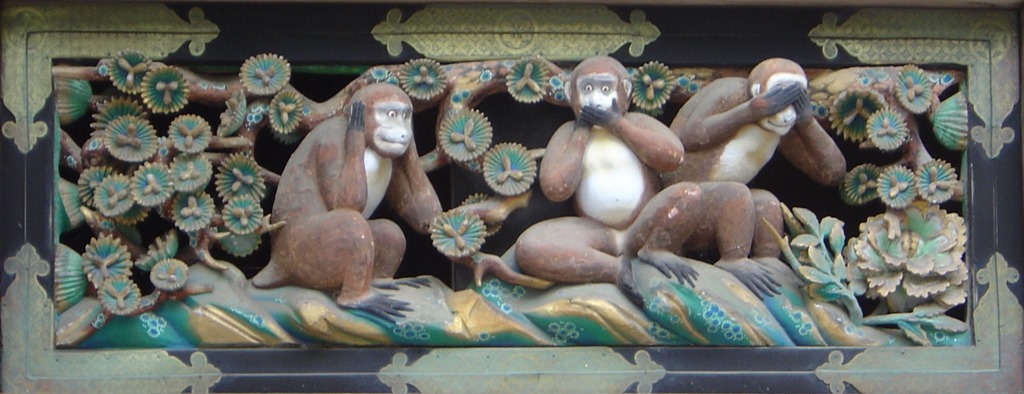
Almost everyone is familiar with the picture of the three monkeys: one covers his mouth, the second covers his eyes, the third covers his ears. In Buddhism they are referred to as “The Three Sage Monkeys”, because they speak no evil, see no evil, and hear no evil. For the spiritual aspirant, this is an ideal to strive for and a spiritual practice to apply. Only beings with a very high level of attainment can actually display it in their lives, and in their example inspire others.
Maharishi Mahesh Yogi, the famous guru who founded Transcendental Meditation, used to tell a story in this regard. One Indian saint was known for his insistence on only seeing the positive in every situation. Some youngsters decided to test him by asking him to accompany them thorough a street where a dead corpse of a cat who has just been run over by a car lay on the road: a gory and highly unpleasant site.
“Look at that cat!” said one of the boys. “What a ghastly sight!”
“Look at the beautiful, pearly white teeth of the cat” responded the saint.
Indeed, as Shakespeare pointed out:
There is nothing either good or bad, but thinking makes it so.
* * *
“Evolution shaped the human brain to be acutely aware of all potential dangers,” says Abundance authors Peter H. Diamandis and Steven Kotler. In addition, in the process of our cultural evolution and the increase individuation, we have also become acutely aware of all the wrong that has been done to us as well as to others.
But Joseph’s generosity and magnanimity towards his brothers, and his wide, saintly perspective expressed in the Midrash story, is giving us a powerful message: that part of our spiritual striving, which includes our commitment to tikkun olam, the repair of the world, is the commitment to favor that part of ourselves that sees beyond those biologically and culturally conditioned modes of perception and interpretation. It is enjoined upon us to strive to cultivate a vision that sees everything, good or bad, coming from God, or, indeed, as God in action. As the Breslov Hassids put it—
הכל מכל עצם זיו חיות אלוקותו יתברך ממשAnything and everything is, in actuality, the very essence of the radiance of the liveliness of Him, the Holy Blessed One.
————–
Note: in this regard, here are a few questions that are often asked:
- Is it possible?
- Is it practical?
- Is it desirable?
It is definitely possible. In every generation there are saintly people of all cultures who have demonstrated this ability to focus on the highest, “keep their eyes on the prize”, and ignore the enormous suffering that they have to undergo in order to get there. Nelson Mandela is one obvious example. Like Joseph, he had to undergo tremendous suffering, including being incarcerated under severe conditions. And when he emerged, he maintained the highest possible perspective and harbored no bitterness.
It’s definitely practical. It does mean transcending narcissism and victimization—a tall order in a post-modern, self-absorbed culture of me that we all live in. It is not easy, but it’s definitely achievable.
As the great Indian teacher Paramahansa Yogananda, speaking about the difference between a saint and a sinner, said: “A saint is a sinner who never gave up.” It’s not about being perfect, it’s about persistence and commitment.
One of the most effective means of cultivating some distance from, and perspective over, one’s emotional experience is meditation. In meditation we assume no relationship to the content of our consciousness—thoughts, emotions, memories, etc. A regular practice of meditation allows one to have more objectivity in moments of great turmoil and upheaval. But meditation is most effective in this regard if one also couples it with a commitment to a cause higher than oneself. In fact, that in itself is a kind of meditation, because it remove the focus from one’s petty concerns and self-absorption to a goal much larger than oneself.
As for whether or not it is desirable, one can only look at history and realize, that every great advancement in the history of our civilization occurred because of people who had a vision that transcended their difficulties, even if those included intense personal suffering on their behalf.
Copyright © 2014 Igal Harmelin-Moria
(Copyright does not pertain to illustrations)